
Table of Contents
Selecting Quality Trailer Hubs in Elkhart, Indiana
Once bearings are assessed, selecting the right trailer hubs is next. In Elkhart, Indiana’s RV manufacturing hub, we match trailer hubs to axle load ratings and trailer weight for safe, reliable performance on local roads.
Focus on these key criteria from Axle Inc.’s comprehensive FAQ guidance:
- Smooth rotation of trailer hub bearings without grinding.
- No corrosion on 5 lug trailer hubs.
- Intact grease seals to prevent contamination.
- Hub bore compatibility with spindles.
We recommend Dexter brand hubs, available through our Granger location as a local inventory source for premium components. They meet industry standards and testing.
Contact Axle Inc. today for custom fits and professional installation to avoid failures. Pair your new hubs with trailer hub bearing service in Elkhart, Indiana. After hub selection, ensure proper installation via local experts.
Essential Preparations for Trailer Hub Replacement
Once you’ve confirmed the need for replacement through signs of hub failure, prioritize these preparations for trailer hubs. Proper setup ensures safety and efficiency, preventing accidents during the process. We at Axle Inc. emphasize a systematic approach based on our service expertise.
Safety Checklist
- Chock the trailer wheels securely to prevent rolling; use heavy-duty blocks on both sides.
- Disconnect any electrical connections and battery to avoid shocks or shorts.
- Wear protective gloves and eyewear; safety warnings: never work under an unstabilized trailer.
Required Tools
- Hydraulic jack rated for your trailer’s weight, plus jack stands.
- Torque wrench set to 75-85 ft-lbs for lug nuts, breaker bar, and hub grease packer.
Pre-Replacement Inspection
- Spin the hub to check trailer hub bearings for grinding noises, play, or heat damage per Axle Inc. best practices.
- Photograph the existing setup, including 5 lug trailer hubs configuration, for reassembly reference.
Set up on a flat, level surface with good lighting and space for parts. For expert help nearby, consider trailer hub bearing service in South Bend, Indiana. Fully prepared, you’re ready for safe hub removal.
Determine Your Trailer Hub Specifications
Once your trailer type is known, pinpoint trailer hub specifications next. Accurate measurements prevent mismatches that compromise safety and performance. We guide you through identifying bolt pattern, trailer hub bearings, capacity, and lug count for exact replacements.
Follow these steps:
- Measure the bolt circle diameter (BCD) using a ruler or template. Common patterns include 4, 5, or 6 lugs; for example, 5 lug trailer hubs typically measure 4.5 inches.
- Remove the hub to inspect stamped codes on cones and cups, such as L44649 inner and L44610 outer trailer hub bearings, per Axle Inc. FAQ.
- Use a caliper to check axle tube diameter (1.75″, 2″, or 3″) and spindle length from the axle end.
- Verify hub drum weight rating (e.g., 1,000 lb or 3,500 lb) against trailer VIN or axle tag, matching Axle Inc. specification charts.
Safety note: Mismatched hubs can cause wheel failure.
Cross-reference specs with manufacturer charts. Contact our Elkhart, IN team with measurements for confirmation. With specs confirmed, browse compatible options below.
Select the Right Trailer Hubs for Sale
Selecting the right trailer hubs starts with ensuring compatibility with your trailer’s axle system. We at Axle Inc. guide customers in Elkhart, IN, to match components for safety and performance, building on essential axle-hub connections.
Follow these key criteria from our expert internal FAQ guidance by Axle Inc. specialists:
- Match bolt pattern: Choose 5 lug trailer hubs for common 3,500 lb axles.
- Select bearings: Opt for grease or oil trailer hub bearings sized correctly for smooth operation.
- Verify capacity: Use 1,000 lb hubs for light loads, 3,500 lb for medium-duty trailers.
- Consider type: Drum hubs for braking, idler for non-braked; for flexible suspension, check torsion axles.
- Confirm spindle size and seal fit before buying.
Shop compatible trailer wheel hubs now at our online parts store. Proper selection ensures reliability—next, learn hub installation for optimal setup.
Order Trailer Hubs from Axle Inc.
When it’s time to replace your trailer hubs, trust Axle Inc. for superior quality, quick delivery, and unmatched reliability. We’re committed to delivering parts you can count on — built for performance, backed by quality and our 60+ years of combined experience. As a BBB A+ accredited provider, we ensure your trailer stays road-ready.
We stock premium trailer hubs, including 5 lug trailer hubs and trailer hub bearings, compatible with various trailer axles from 3.5K to 7K capacities. These hub assemblies for trailers fit utility, RV, and cargo needs seamlessly, positioning them as ideal for axle upgrades.
Ordering is straightforward:
- Visit axleinc.com and browse our e-commerce parts store.
- Select the perfect hub model for your setup.
- Add to cart and checkout securely.
- For custom orders, contact us via phone or email.
South Bend, IN customers can access our professional installation post-purchase, as detailed on our local service page demonstrating expertise in trailer components.
Order your trailer hubs today from Axle Inc. Professional fitting available to get you back on the road fast.
Prepare Your Trailer for Hub Installation
Now that you’ve selected your trailer hubs, preparation is key to a safe installation. We at Axle Inc. recommend starting with thorough checks to ensure compatibility and compliance.
Safety first: Jack up the trailer securely on level ground and place wheel chocks at all non-lifted wheels.
Follow these steps:
- Inspect existing trailer hub bearings for wear, scoring, or damage; replace if necessary before installing new trailer hubs.
- Measure axle spindle dimensions precisely to confirm fit with 5 lug trailer hubs.
- Clean axle mounting surfaces using a wire brush and degreaser to remove rust and old grease.
- Verify your trailer’s weight rating matches the hub capacity, adhering to NHTSA trailer hub standards as authoritative federal motor vehicle safety standards from the National Highway Traffic Safety Administration (NHTSA).
- Gather tools: torque wrench, bearing packer; ensure workspace is clear.
With your trailer prepped, proceed to hub installation for reliable performance.
Remove the Old Trailer Hub
After confirming the old trailer hub is faulty, safely remove it from the axle to prepare for replacement. Safety first: Chock the trailer wheels, jack up the trailer using a rated jack and jack stands on the frame, and wear safety glasses. We prioritize these precautions at Axle Inc. to prevent accidents.
Tools required:
- Jack and jack stands
- Lug wrench
- Pliers
- Flathead screwdriver
- Mallet
- Wire brush
- Loosen lug nuts on the 5 lug trailer hubs in a star pattern before fully jacking up, then remove the wheel.
- Pry off the dust cap with a flathead screwdriver.
- Remove the cotter pin from the spindle nut using pliers, then loosen the spindle nut while spinning the hub to access the trailer hub bearings.
- Pull the hub straight off the spindle, noting the outer bearing, washer, and nut positions. If stuck, gently tap with a mallet.
Inspect the removed hub for wear like bearing play, corrosion, or seal damage per SAE wheel hub design criteria, as outlined by the Society of Automotive Engineers (SAE). Place the inner bearing and grease seal in a clean container.
With the old hub off, clean the spindle and prepare for new hub installation.
Install the New Trailer Hub
With the old hub off, prepare for installing the new trailer hub. Safety warning: Position wheel chocks securely, use a hydraulic jack rated for your trailer’s weight, and wear safety glasses at all times.
Tools and materials needed:
- Bearing packer or high-temperature wheel bearing grease
- Puller tool for remnants
- Torque wrench
- Cotter pin and spindle washer
- Remove any remnants of the old hub, such as seals or races, from the spindle using a puller tool.
- Pack the new trailer hub bearings with high-temperature grease using a bearing packer or hand method.
- Slide the new hub assembly onto the clean spindle, ensuring the inner bearing seats fully, then install the inner grease seal.
- Add the spindle washer and castle nut (a notched nut securing the hub), torque to 20-30 ft-lbs while rotating the hub to seat bearings, back off 1/6 turn, and insert cotter pin.
- For 5 lug trailer hubs, hand-tighten lug nuts in a star pattern, lower the trailer, then final torque to 80-100 ft-lbs.
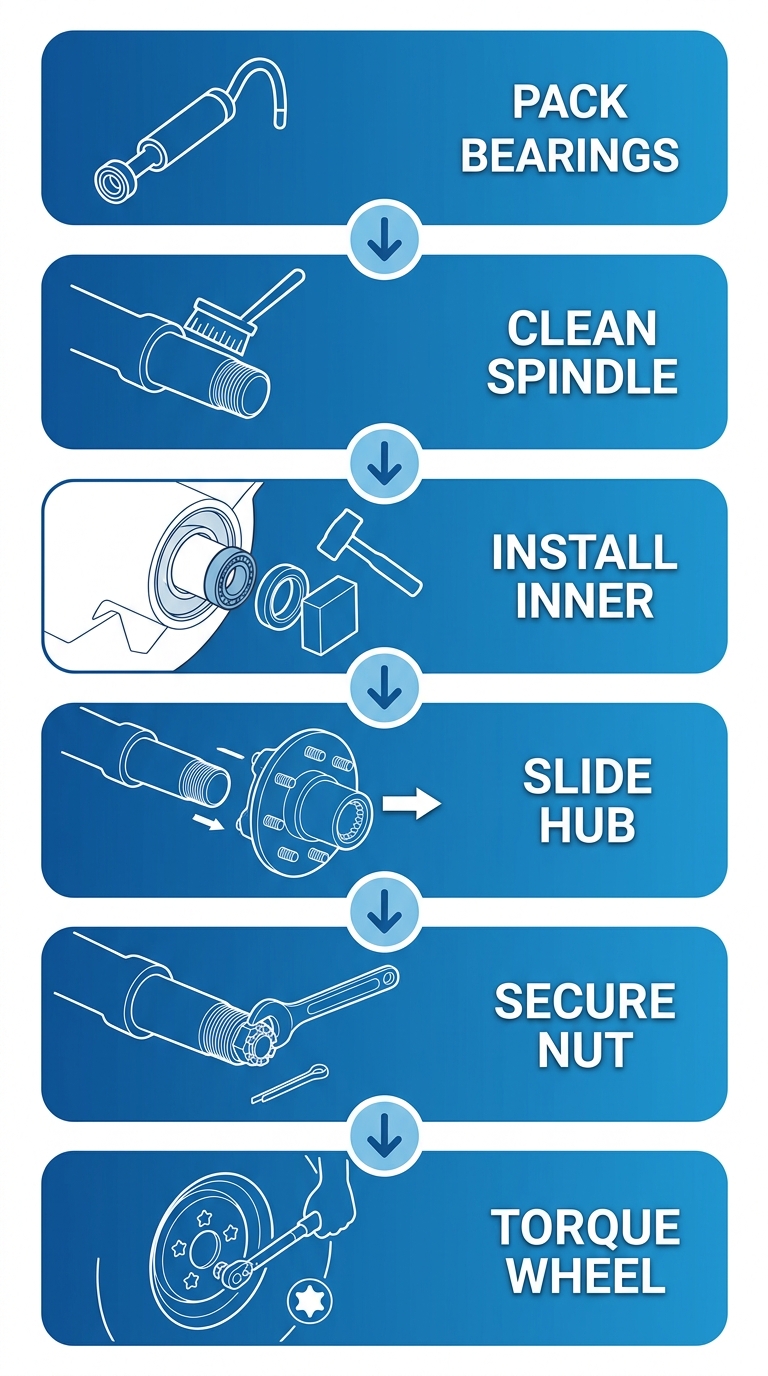
Step-by-step guide to installing a new trailer hub with Dexter parts
Source Dexter-compatible replacements from Axle Inc., our internal supplier in Elkhart, IN. End with a test spin: rotate the trailer hub to check for smooth operation without wobble. After hub installation, lower the trailer and verify alignment before testing brakes and axles.
We’re committed to delivering parts you can count on — built for performance.
Perform Final Tests and Checks
With trailer hubs now assembled and mounted, conduct these essential final tests following Axle Inc.’s official step-by-step FAQ guidance for post-installation verification. This ensures secure mounting and safe road performance.
- Visual Inspection: Examine trailer hubs for damage, proper seating of trailer hub bearings, and alignment of 5 lug trailer hubs.
- Lug Nut Torquing: Torque all lug nuts on 5 lug trailer hubs to 90-120 ft-lbs using a calibrated torque wrench in a star pattern.
- Spin Test: Rotate each hub by hand; confirm smooth motion without grinding, binding, or excessive play in trailer hub bearings.
- Temperature Check: After a short tow, measure hub temperature with an infrared thermometer—should not exceed 180°F.
- Seal Verification: Ensure grease caps are secure, zerk fittings accessible, and no leaks around bearings.
- Alignment Shake Test: Shake wheels at 12, 3, 6, and 9 o’clock positions; limit play to 1/8 inch.
- Documentation: Record checks with photos or notes for warranty support.
With all final checks passed, your trailer hubs are road-ready for reliable service.
Troubleshooting Common Trailer Hub Issues
Even with proper care, trailer hubs can develop issues. Here is how to spot and address them. Common symptoms include unusual noises like grinding or humming, excessive heat from the hub area, wobbling wheels, and grease leaks. These signs often point to trailer hub bearings failure or lubrication problems. Axle Inc. notes that 30% of trailers need bearing repairs annually, per industry standards.
Follow these diagnostic steps safely. Always chock the wheels, use jack stands, and never exceed trailer weight ratings during troubleshooting.
- Jack up the trailer securely. Spin the wheel by hand to check for roughness or grinding in the trailer hub bearings. Smooth rotation indicates healthy bearings; resistance signals wear.
- Inspect visually for damage, play, or looseness in 5 lug trailer hubs. Look for pitted, scored, or contaminated bearings. Axle Inc., as local experts in Elkhart, IN, recommends repacking trailer hub bearings every 3,000 miles or annually to prevent overheating.
- Repack bearings if needed. Clean old grease, apply high-temperature wheel bearing grease, and torque lug nuts to 85-100 ft-lbs on 5 lug trailer hubs. Our technicians with over 60 years of combined experience advise professional checks for best results.
Replace bearings if pitted or excessively worn. Hub damage affecting the spindle may require trailer axle replacement. Axle Inc. provides these services efficiently, with repacks taking 1-2 hours.
For complex repairs, professional intervention is key. Contact us at Axle Inc. in Elkhart, IN, or in South Bend, IN, for expert trailer hub bearing service or trailer axle replacement. Schedule online today for reliable support.
Professional Trailer Hub Services in Elkhart, Indiana
Focusing on Elkhart’s trailer hub needs, we at Axle Inc. proudly deliver professional trailer hubs services in Elkhart, Indiana. Our expert technicians, with over 60 years of combined experience, install and repair trailer hubs for RVs, utility trailers, boat trailers, and more.
We offer comprehensive replacement of trailer hub bearings and 5 lug trailer hubs using genuine Dexter parts from our inventory near Granger, IN. As Axle Inc., our local stock ensures quick service turnaround, often same-day, for enhanced safety and durability on Indiana roads. These warranty-backed installations provide reliable performance and peace of mind.
Key benefits include:
- Superior strength for heavy loads
- Corrosion resistance for local weather
- Extended lifespan through proper maintenance
Schedule your trailer hubs service with us in Elkhart, Indiana today. Beyond hubs, explore our full axle services.
This article was researched and written with the assistance of AI tools.
Resources
- Get Quality Torsion Axles 600-15,000 lbs for Trailers
- Book Expert Trailer Hub Bearing Repack in Elkhart
- Find Reliable Trailer Hub Bearing Service in South Bend
- Get Fast Trailer Axle Replacement Service in South Bend
- Compare Heavy-Duty Trailer Axles 3,500-7,000 lbs Options
- Upgrade Cargo Trailer Axles with Professional Installation Guide
- Source Dexter Axle Parts Repairs Maintenance in Granger
- Access NHTSA Vehicle Recall Safety Reporting Resources
- Explore SAE Wheel Hub Design Durability Criteria Standards